The Emmaus Cycle | Wall Paintings in Context and Close Up
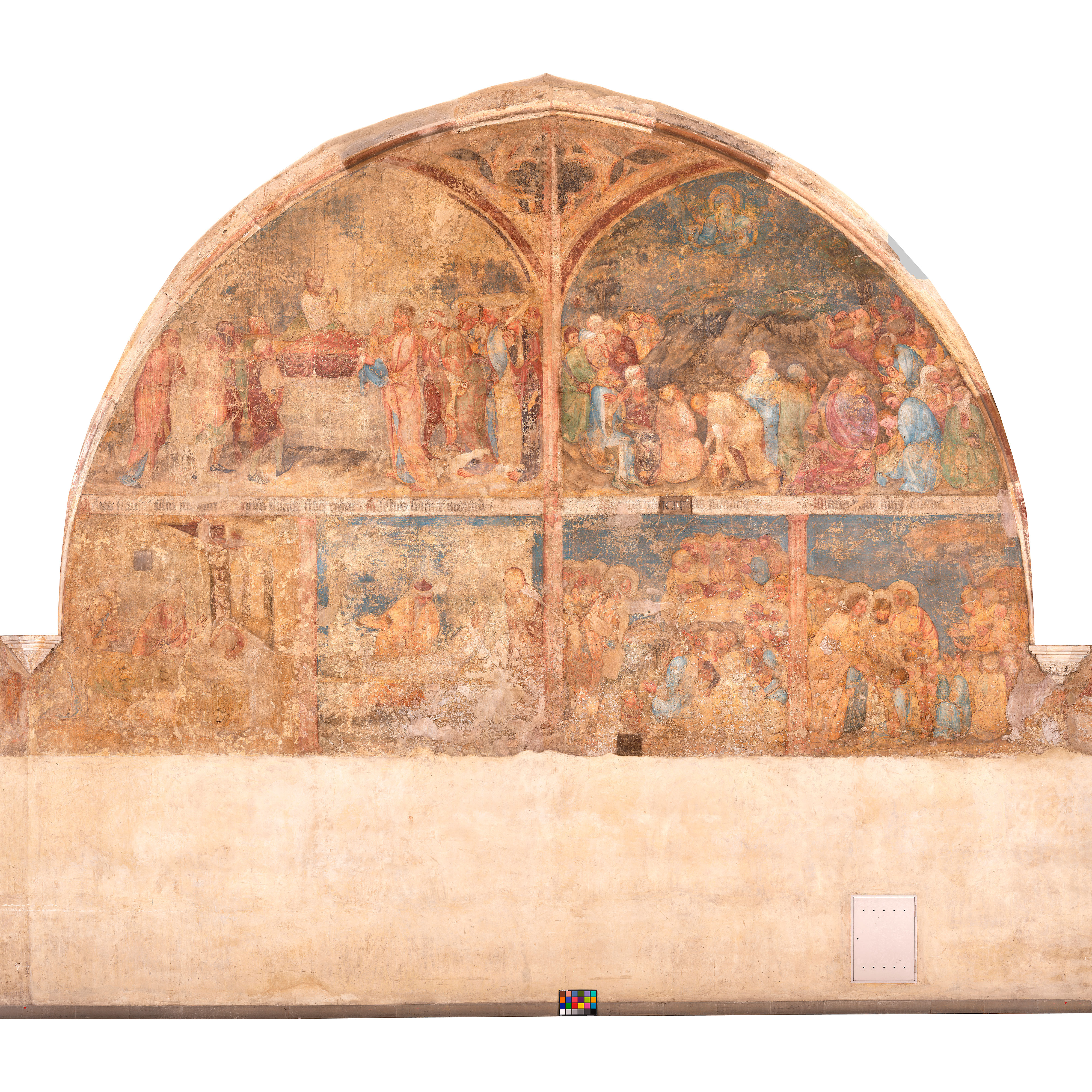
The Raising of the Widow’s Son at Nain
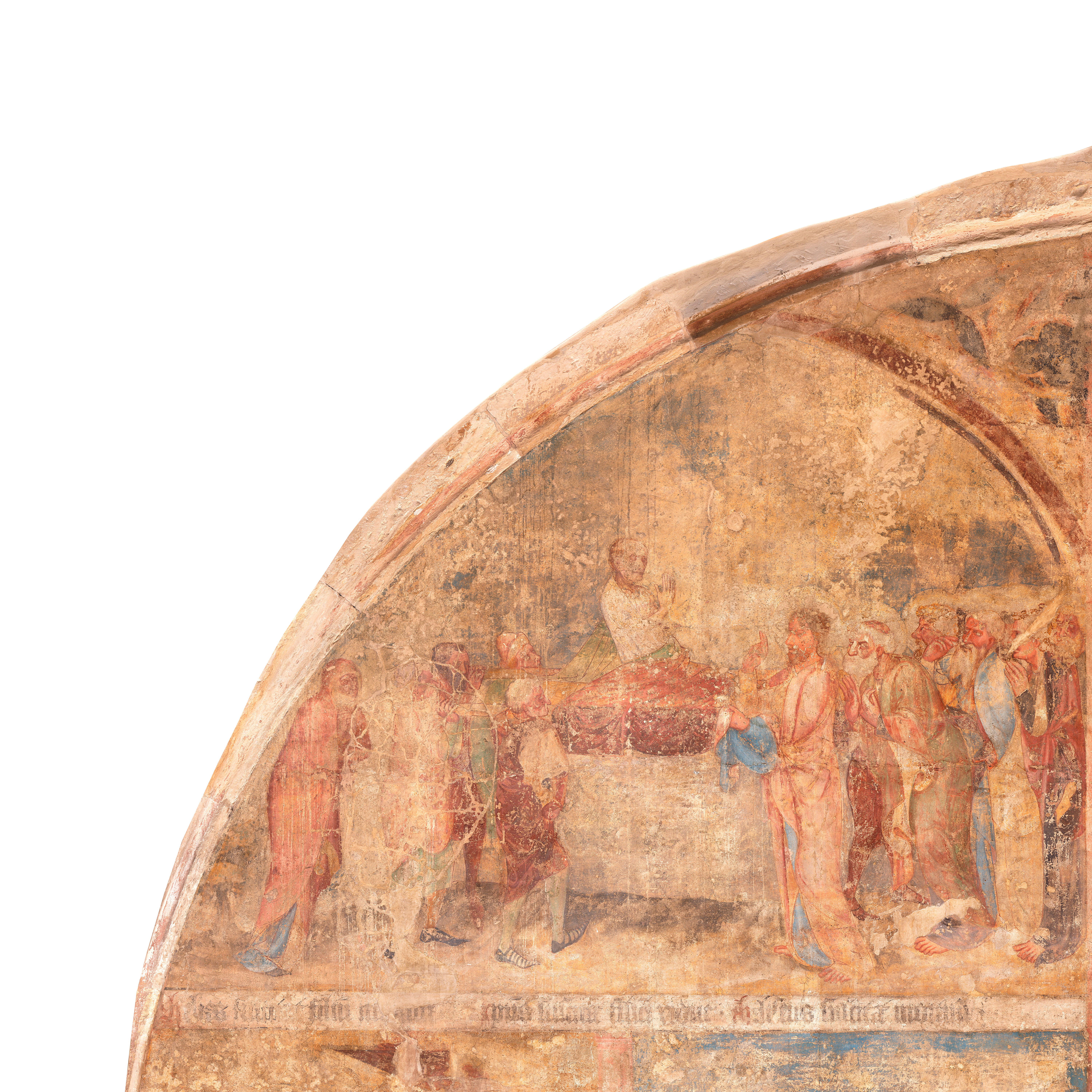
The Raising of the Widow’s Son at Nain (Luke 7:11–15) – Elijah Raises the Widow’s Son at Zarephath (1 Kgs 17:17–24) – Elisha Raises the Shunammite’s Son (2 Kgs 4:18–37)
Inscriptions: Helias suscitat filium mortuum. Xpus suscitat filium vidue. Heliseus suscitat mortuum. (Elijah raises the dead son. Christ raises the widow’s son. Elisha raises the dead.)
Uppsala description: Helyas reviviscere fecit puerum. Ihesus in civitate Naym suscitavit mortuum. Ad tactum Helye resuscitatur mulier. (Elijah brought the boy back to life. Jesus raised the dead man in the city of Nain. At Elisha’s touch, a woman is revived.)
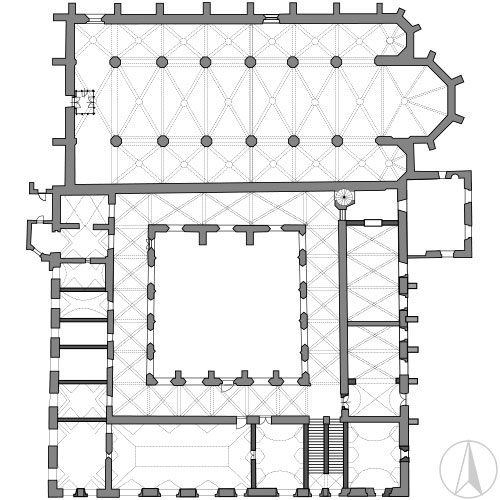
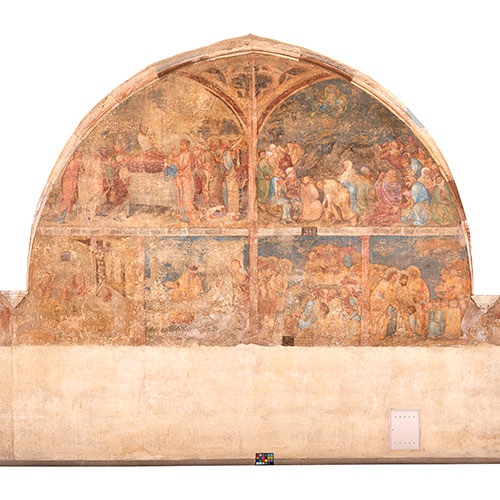
This composition is the first of the pairings arranged in double-width fields. The vault bays in the cloister here adapt to the width of the adjacent church’s vaults. As a result, each pair of compositions was separated from the others by painted illusionistic architecture.
a. When Jesus was approaching the city of Nain, he encountered a funeral procession at the city gate, carrying the body of a widow’s only son. Moved with compassion, Jesus raised the young man, who sat up on the bier and began to speak.
In the scene of The Raising of the Widow’s Son at Nain, the bier is depicted in the center, carried by several men. In fact, only four bearers are visible behind the bier on the left side of the scene, while just one set of legs can be seen on the right -presumably the rest of the figures were left out as they would have been obscured by those in the foreground. From the right, Jesus approaches and blesses the dead boy with his raised right hand. The revived son is already sitting up on the bier with hands folded in prayer, though his face still looks corpse-like. On the far left, his mother watches the miracle, her hands devoutly clasped in front of her chest. The surprised apostles stand behind Jesus on the opposite side of the composition. In the foreground is Saint Peter, easily recognizable. Both gestures and facial expressions convey their astonishment.
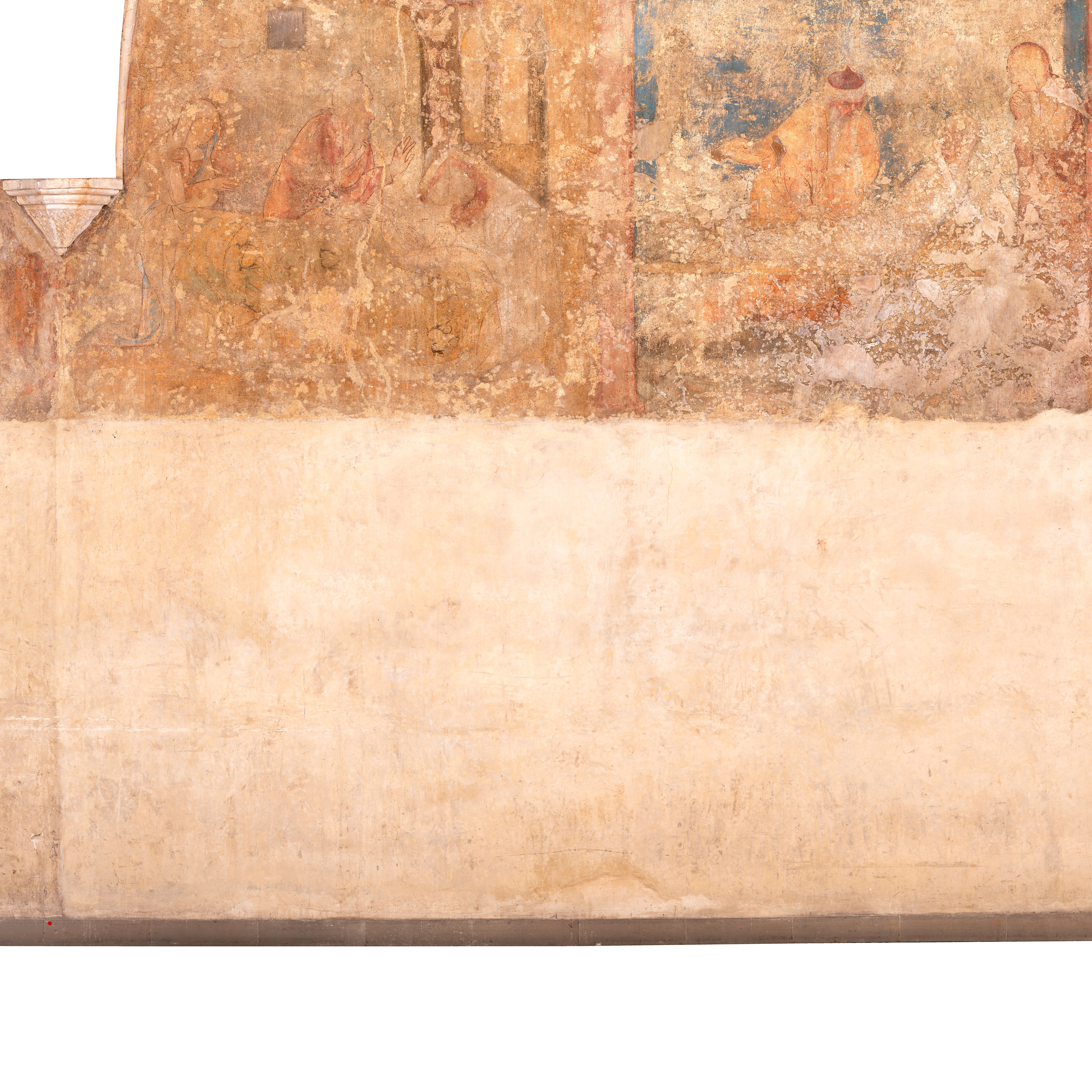
b. The first typological parallel depicts a story from the life of the prophet Elijah. For a time, he stayed with a widow in Zarephath. Her son fell ill and died. Elijah carried the boy’s body to his room, laid it on the bed, bent over him three times, and pleaded with the Lord. The Lord heard his prayer and restored the boy’s life.
The scene takes place indoors. In the foreground stands a bed with a canopy over the head of the lifeless young man lying on it. The prophet stands behind the bed, touching the boy’s hands with his right hand and raising his left in a gesture of blessing. The mother, who according to the Bible waited downstairs in the house, is depicted on the left, kneeling and pointing toward her son with her right hand.
c. The prophet Elisha performed a similar miracle. A boy died who belonged to a woman from Shunem, with whom the prophet often stayed. The child was laid on the prophet’s bed. When Elisha arrived, he lay down on the boy—face to face, hands to hands. Then he got up, walked around the house, and bent over the boy again. The child sneezed seven times and opened his eyes.
The scene, however, diverges from the biblical description in several respects. The man’s (not boy’s) body is wrapped in linen and lies not on a bed, but on a bier resting on the ground. The prophet is shown bending over the bier at the moment when the dead boy begins to rise. The Shunammite woman stands to the right, behind her son’s head, hands clasped in prayer, looking down at him.
The not often depicted scene of the young man from Nain was chosen not only to demonstrate Jesus’s power to raise the dead, but also because it features the figure of grieving mothers, who were commonly interpreted as a prefiguration of the Church, mourning over the sinner and interceding on his behalf. The resurrection of the dead foreshadows those dead in sin, who are called to eternal life through forgiveness. The Sacrament of Reconciliation is one of the future missions of the Church.
The choice of the prophets Elijah and Elisha, whom we will encounter again on this wall, is probably related to the fact that Elijah in particular was regarded as the founder of monastic life and a model for all monks.
The Gathering of Manna
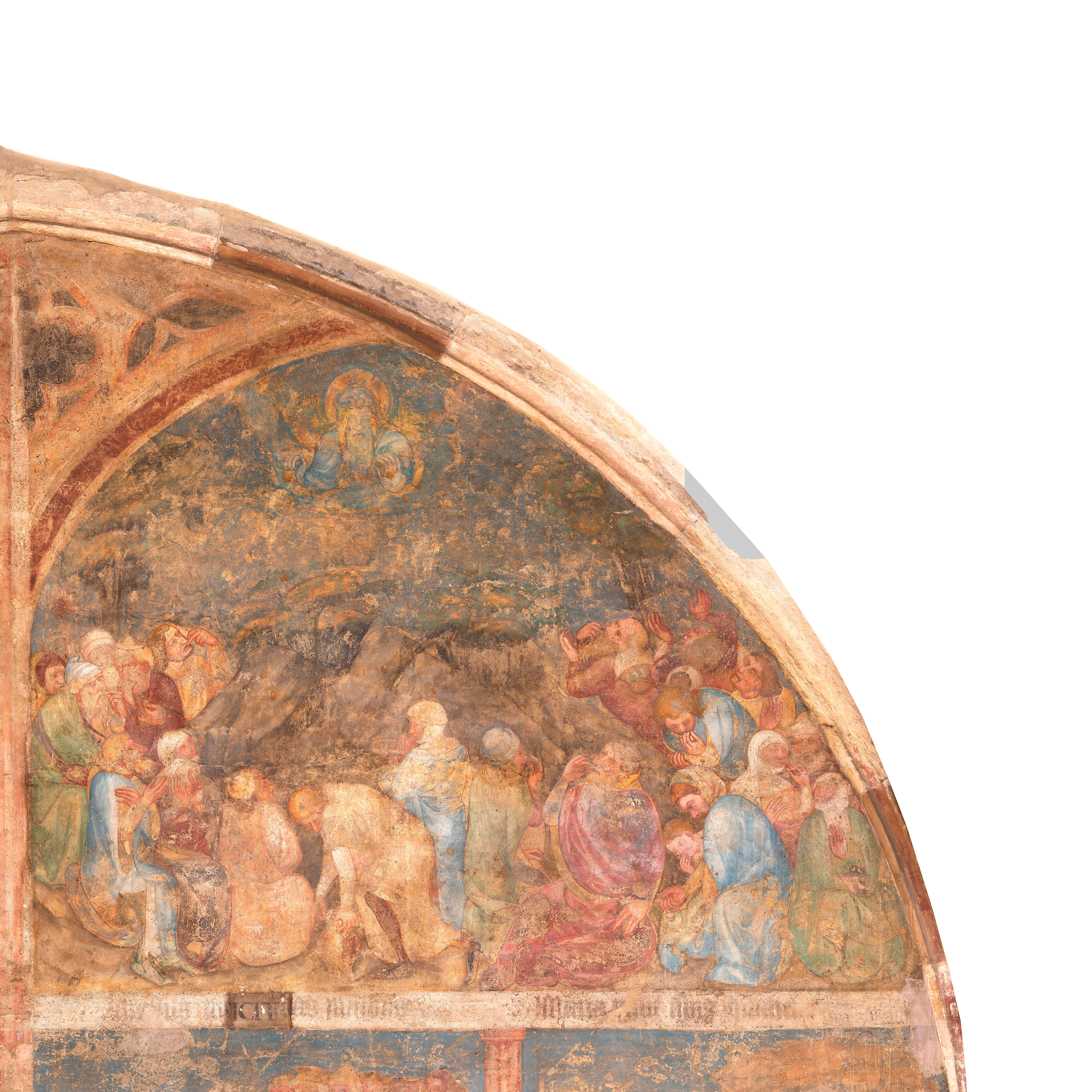
The Gathering of Manna (Exod 16:14–17) – The Two Miraculous Feedings of the Multitudes (Matt 14:13–21 and 15:32–39)
Inscription: Christus reficit turbas panibus. Mana pluiit filiis Israhel. (Christ fed the multitudes with loaves. Manna rained down upon the sons of Israel.)
At the far right of the inscription band are fragments of a different Gothic script written in two lines.
Uppsala description: Saciavit Dominus 5000 hominum cum duobus piscibus. Pluit illis manna ad manducandum. Saciavit Dominus 4000 cum quinque piscibus. (The Lord fed 5,000 people with two fish. Manna rained down for them to eat. The Lord fed 4,000 with five fish.)
In this composition, the positioning of the scenes is unusually reversed: the Old Testament episode appears above, while the two New Testament scenes are below. This change was likely made due to the common interpretation of all three scenes as prefigurations of the Last Supper, and thus of the institution of the Eucharist. Administering the sacrament of the altar is again one of the tasks entrusted to the Church. Furthermore, the larger upper section of the field allowed the Gathering of Manna to be painted on a grander scale. The scenes, therefore, must be read unusually - from bottom to top.
a. The Gospel of Matthew describes two separate miraculous feedings of the crowds who followed Jesus into the wilderness. In the first instance, the crowd numbered five thousand people; in the second, four thousand. The disciples had five loaves and two fish in the first case, and seven loaves and a few small fish in the second. Jesus instructed the crowds to sit down, then gave thanks, broke the loaves, and gave them to the disciples, who distributed them to the people. Everyone ate and was satisfied—and there were leftovers.
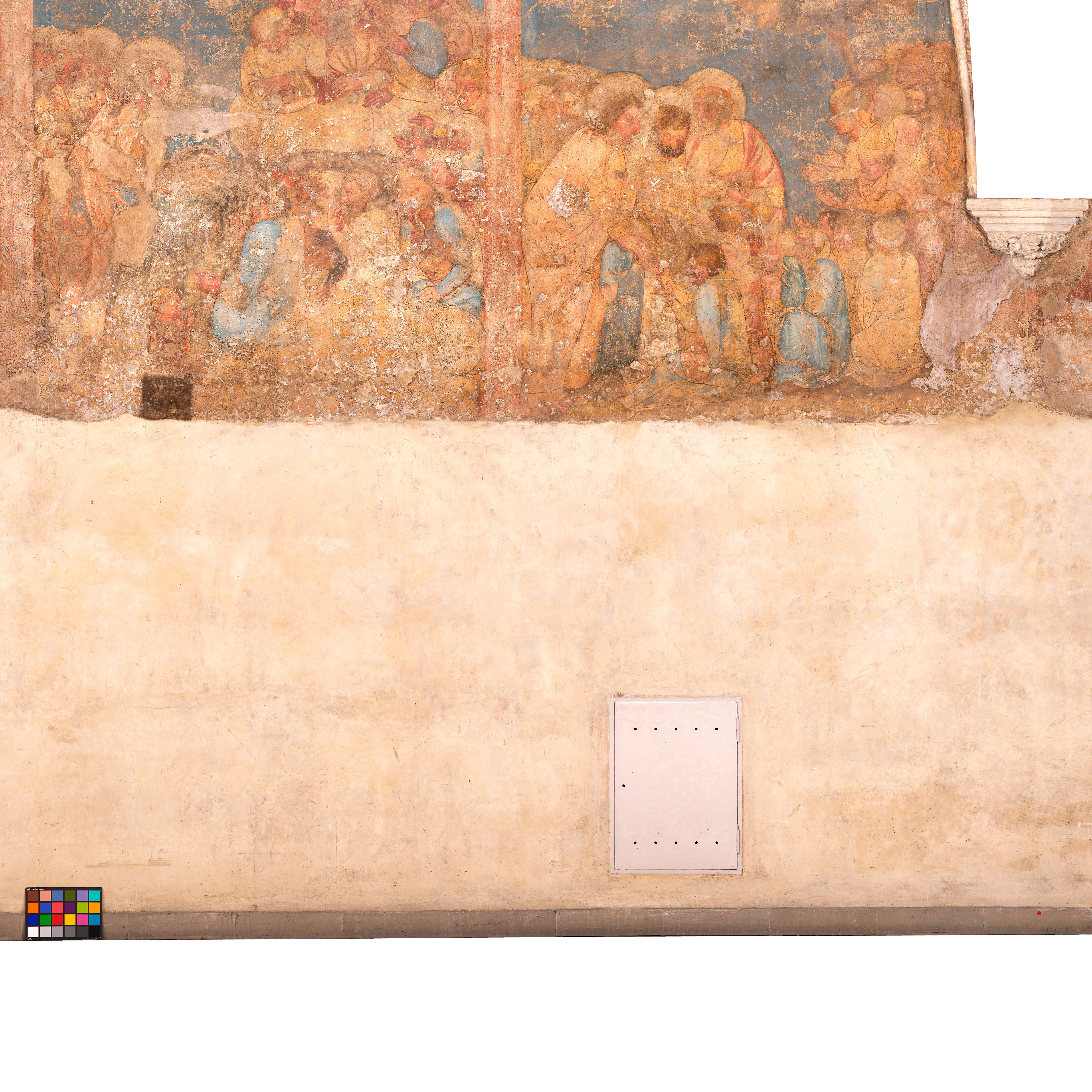
The depictions of the two scenes are very similar: Jesus and the apostles are shown on the left, and the crowds on the right. In the first scene, Jesus holds a bowl with two fish; behind him, Peter carries an armful of loaves. Two more apostles peek out behind them. The crowds are seated in front of Jesus in a U-shaped formation. Those in the lower part are sitting on what appear to be sacks of hay, while the upper group leans on them. This detail seems to have served to distinguish the two scenes, since in the second depiction, the sacks are absent. In the Gospel, it is written that the people were seated “on the grass”; however, the Latin word foenum can mean both grass and hay.
b. In the second scene, Jesus stands at the far left and is handing a piece of bread to the first seated man. A few apostles are visible behind Jesus, while in front of him, St. Peter and another apostle are preparing five fish and five loaves on a small table. The people are seated on the ground before Jesus, while more crowd in from the right. In both scenes, the crowds include men and women of different types, with varied gestures and facial expressions.
c. During their flight from Egypt, the Israelites suffered from hunger in the desert. The Lord took pity on them and sent down a kind of dew from heaven every morning, which the Israelites collected and ate.
In the scene, we see at the center a rocky hillock with few trees. Above it, the Lord looks down from heaven - depicted in monochrome - and drops brownish lumps, manna, from his hands. The Israelites surround the hillock: those in the background are standing, those in the foreground are seated. They are shown in a variety of poses - some look up and put the manna into their mouths, others merely watch what is happening, while still others bend down to gather the manna, such as the man at the center of the scene, who crouches to place manna into a jug. The overall effect is very dynamic and full of life.