The Emmaus Cycle | Wall Paintings in Context and Close Up
Carrying of the Cross
Carrying of the Cross (Luke 23:26–32) – Abimelek carries wood (Judg 9:46–49) and Isaac carries wood for the sacrifice (Gen 22:1–13)
Inscription: not preserved
Uppsala description: Christus cruce baiulat. Abymelec ligna defert. Ysaac lignum defert ad ymolandum filium. (Christ carries the cross. Abimelek carries wood. Isaac carries wood to be sacrificed as a son.)
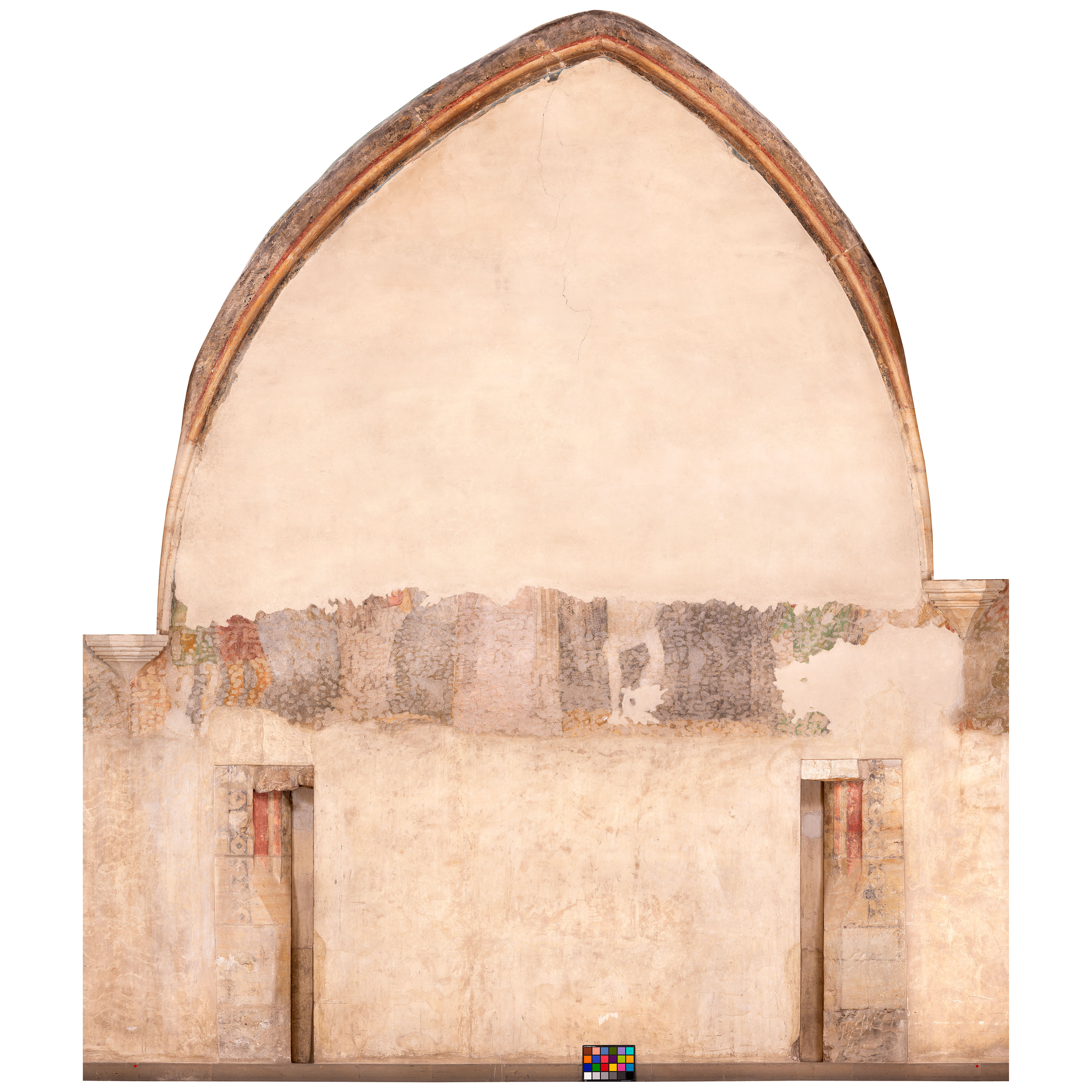
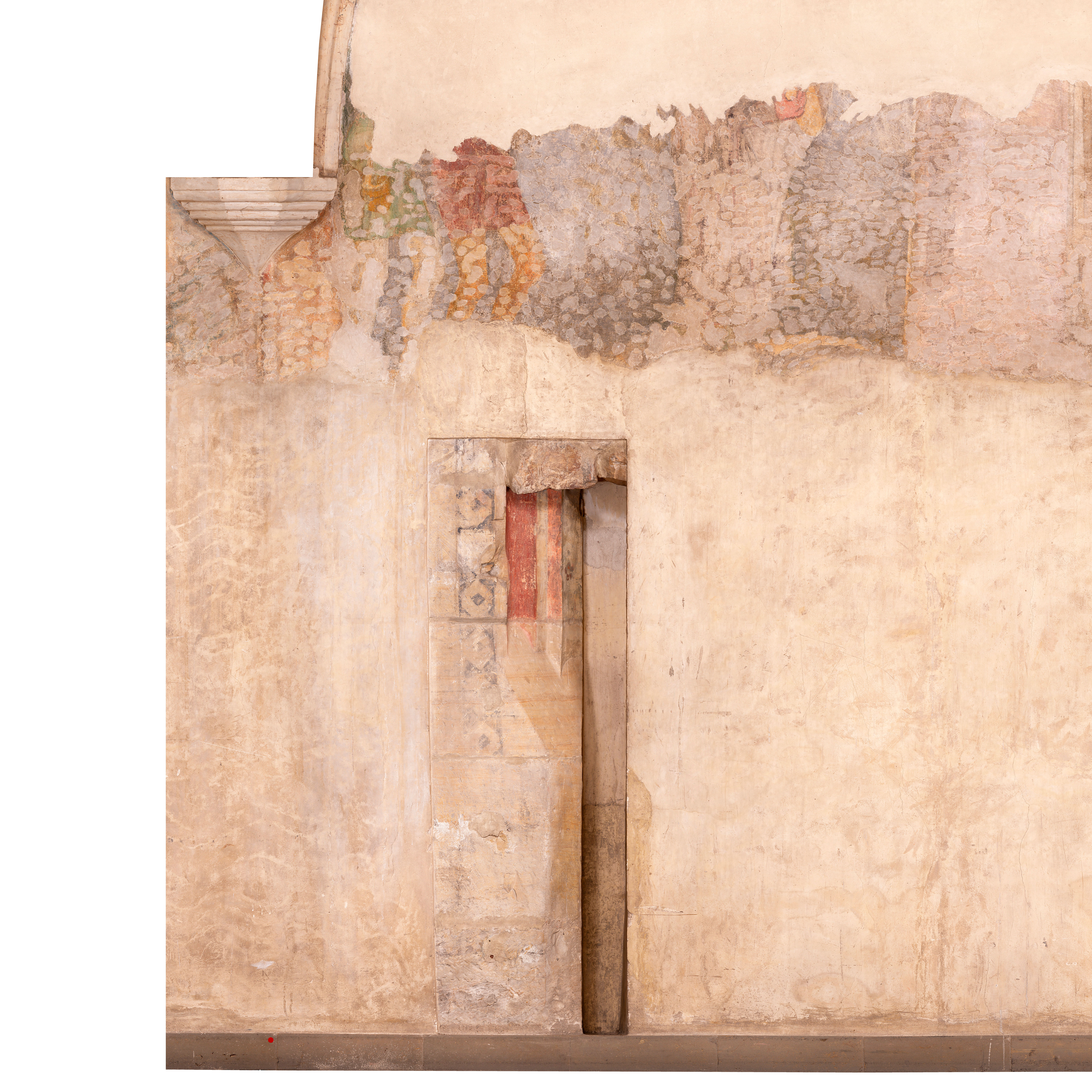
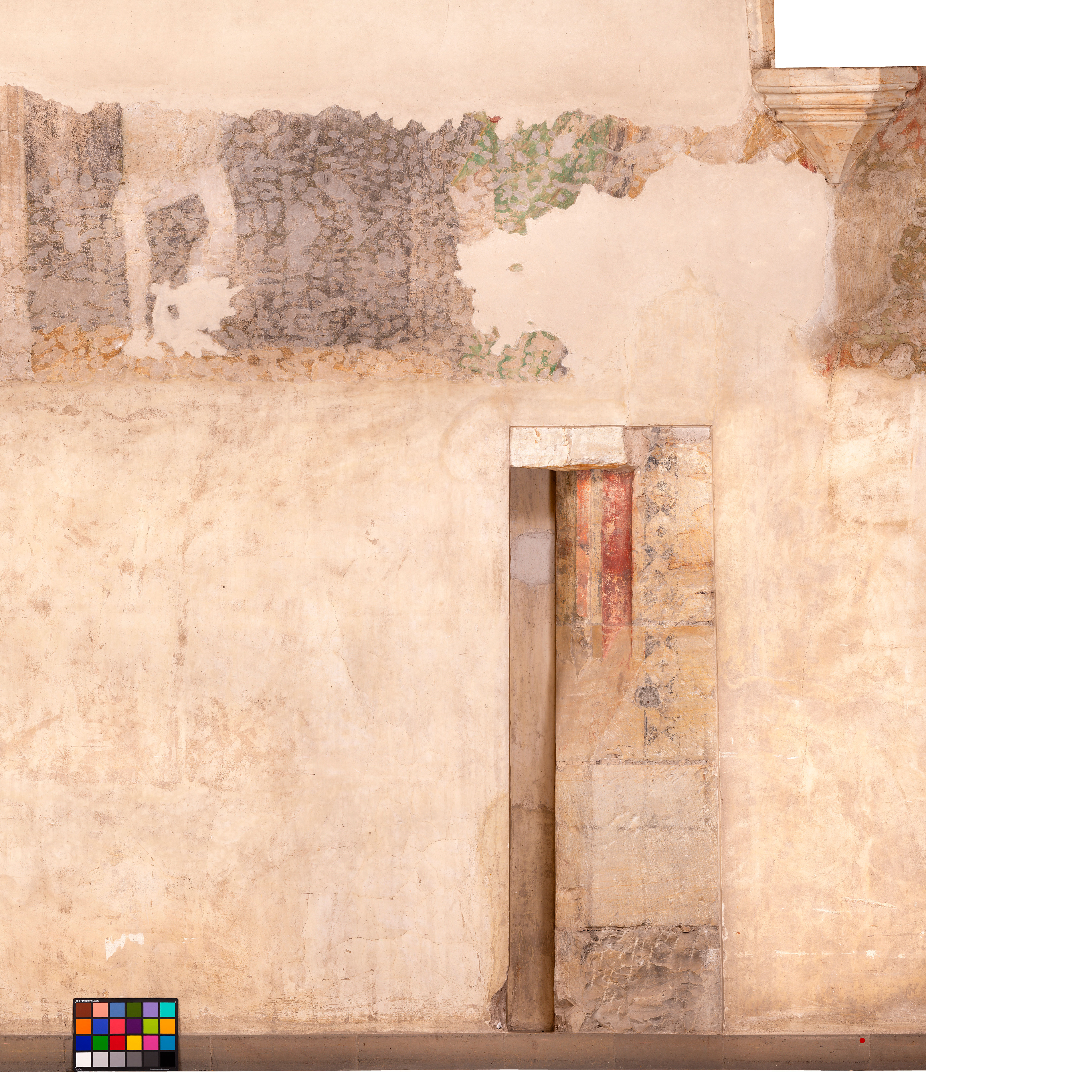
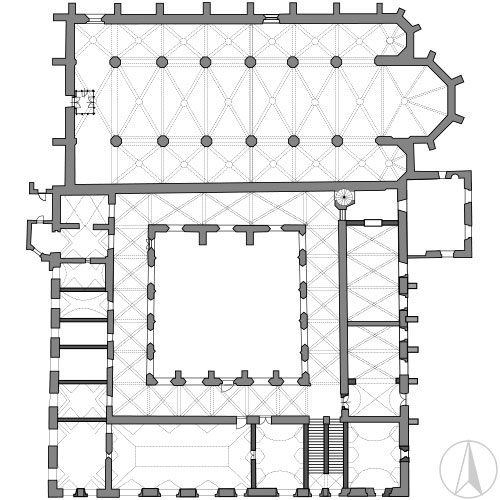
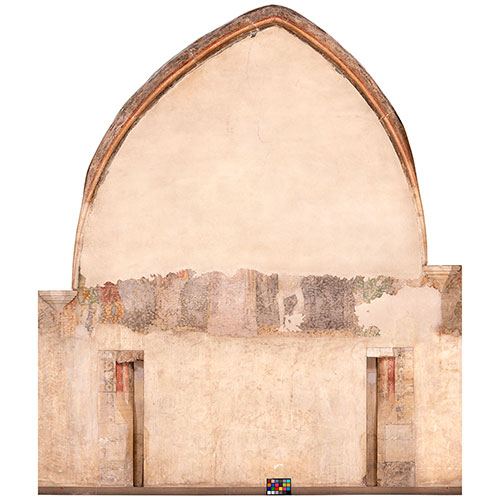
In this field, fragments of the stone jambs of a large portal were uncovered. The portal originally led from the cloister into the hall in the eastern wing. It featured a central column, was not fitted with a door, and was topped with a segmental arch, above which, facing the cloister, there was probably a tympanum decorated with tracery.
The jambs were adorned with floral ornamentation on the side facing the cloister, and with illusionistic tracery on the side facing the hall, alternating with a coat of arms bearing the Bohemian lion and the imperial eagle.
However, the portal was walled up, and a chapel was created in the northern part of the hall, while a new chapter house was established in the southern part. Scenes from the cycle were painted over the masonry infill. These scenes are medieval, but technically distinct from the other paintings - meaning that this painting is later than the rest.
a. The scene of Christ Carrying the Cross, mentioned in the Uppsala description, has not been preserved. A later, early modern overpainting depicted the same subject.
b. According to the description, the scene was supposed to depict the judge Abimelek, son of Gideon, carrying wood to set fire to the city of Shechem, which had rebelled against him. However, it is not certain whether the description was accurate in this case. In the fragment of the lower part of the scene, we can distinguish two male figures on the left. The first, in a green coat, wears a belt with a pouch, which appears to contain a knife. The second man is dressed in red. They are both turned toward a central figure, wearing a long robe and holding something in her right hand. On the far right, there was perhaps a gate.
c. The story of Abraham, who was commanded by the Lord to sacrifice his only son Isaac, is a frequently cited typological parallel. The scene likely depicts the moment when Abraham ascends the mountain with his son, preparing to offer him as a sacrifice. The surviving fragments of figures may correspond to this identification: on the left, we possibly see Isaac’s legs as he carries the wood, and in front of him on the right, a figure in a long green robe - presumably Abraham - walks ahead.
The composition, placed in the central field, once again introduces the theme of the cross. This time, however, it is no longer merely an allusion, but marks the beginning of the journey to Golgotha. After the portal was walled up, any viewer wishing to see the culminating scenes of the Passion had to turn back, enter the church, and from there proceed into the adjacent chapel in the east wing.
Předchozí pole | Následující pole ✖