The Emmaus Cycle | Wall Paintings in Context and Close Up
Jesus Being Stoned in the Vineyard, or the Parable of the Wicked Tenants
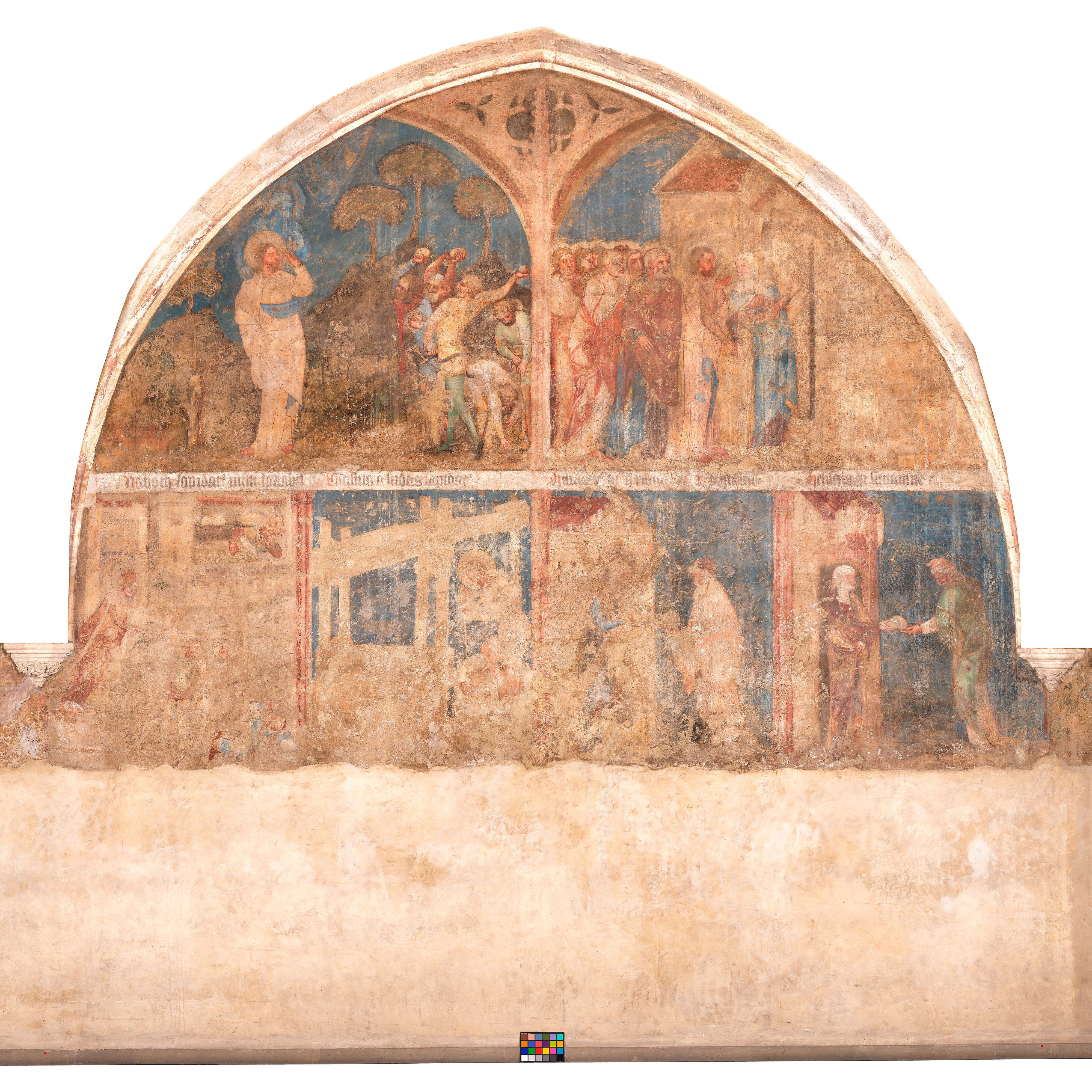
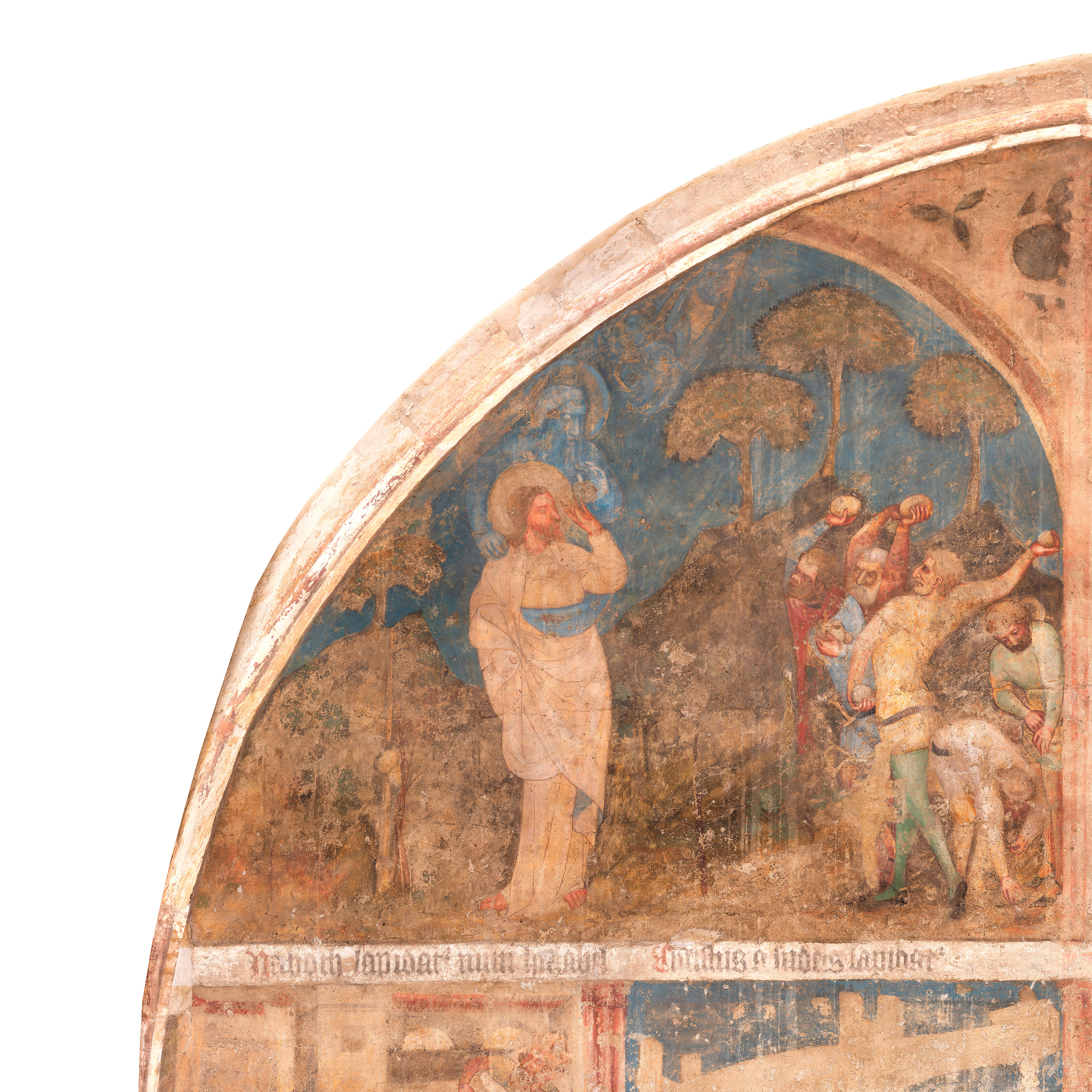
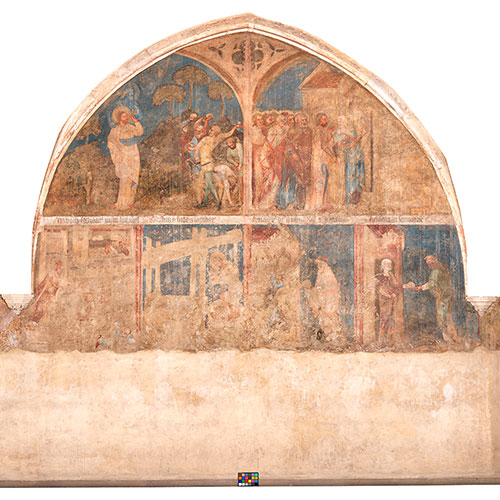
Jesus Being Stoned in the Vineyard, or the Parable of the Wicked Tenants (Matt 21:33–44; Mark 12:1–11; Luke 20:9–15) – The Stoning of Naboth (1 Kgs 21:1–16) and Christ in the Winepress (Is 63:2–3)
Inscription: Naboth lapidatur nutu Hiezabel. Christus a Iudeis lapidatur. (Naboth is stoned at Jezebel’s command. Christ is stoned by the Jews.) There was never a description of the third scene.
Uppsala description: Iesabel lapidari precebit Naboth. Iudei voluerunt Christum lapidare. Torcular calcavit solus. (Jezebel ordered Naboth to be stoned. The Jews wanted to stone Christ. He trod the winepress alone.)
a. The main scene is an interpretation of the Parable of the Wicked Tenants, since the Gospels contain no story in which Jesus is stoned in a vineyard. The parable tells of a householder who planted a vineyard and built a winepress in it, then leased it to tenants. When he sent servants to collect his share of the harvest, the tenants beat or kill them. This happened repeatedly, until the householder sent his own son—whom the tenants killed. The interpretation is clear: the landowner is God the Father, who sent his Son. The unworthy tenants—the Jews—killed him.
Jesus is depicted on the left side of the scene, dressed in a long white robe falling in fluid folds. He gazes to the right, toward his enemies, and lifts his left hand in a gesture that seems to try to halt the attack. Above him, God the Father (rendered in monochrome) looks down from heaven, placing his right hand on Jesus’ shoulder and mirroring Jesus’ gesture with his left. A pair of blue angels descends toward the Lord.To the right is a group of five men. The first, with a pig-like nose, holds a stone above his head and clutches more stones in his other hand. Behind him, a bearded man raises a stone with both hands, and a third man wields a stone in his right hand, pulled back in a throwing motion. Behind them, two more men gather stones. They are all dressed in fashionable, tight-fitting garments belted at the hips. The scene is set in a landscape with several tree-covered hills. Around Jesus, small vine bushes are growing—today, vine leaves painted using a stencil are still visible.
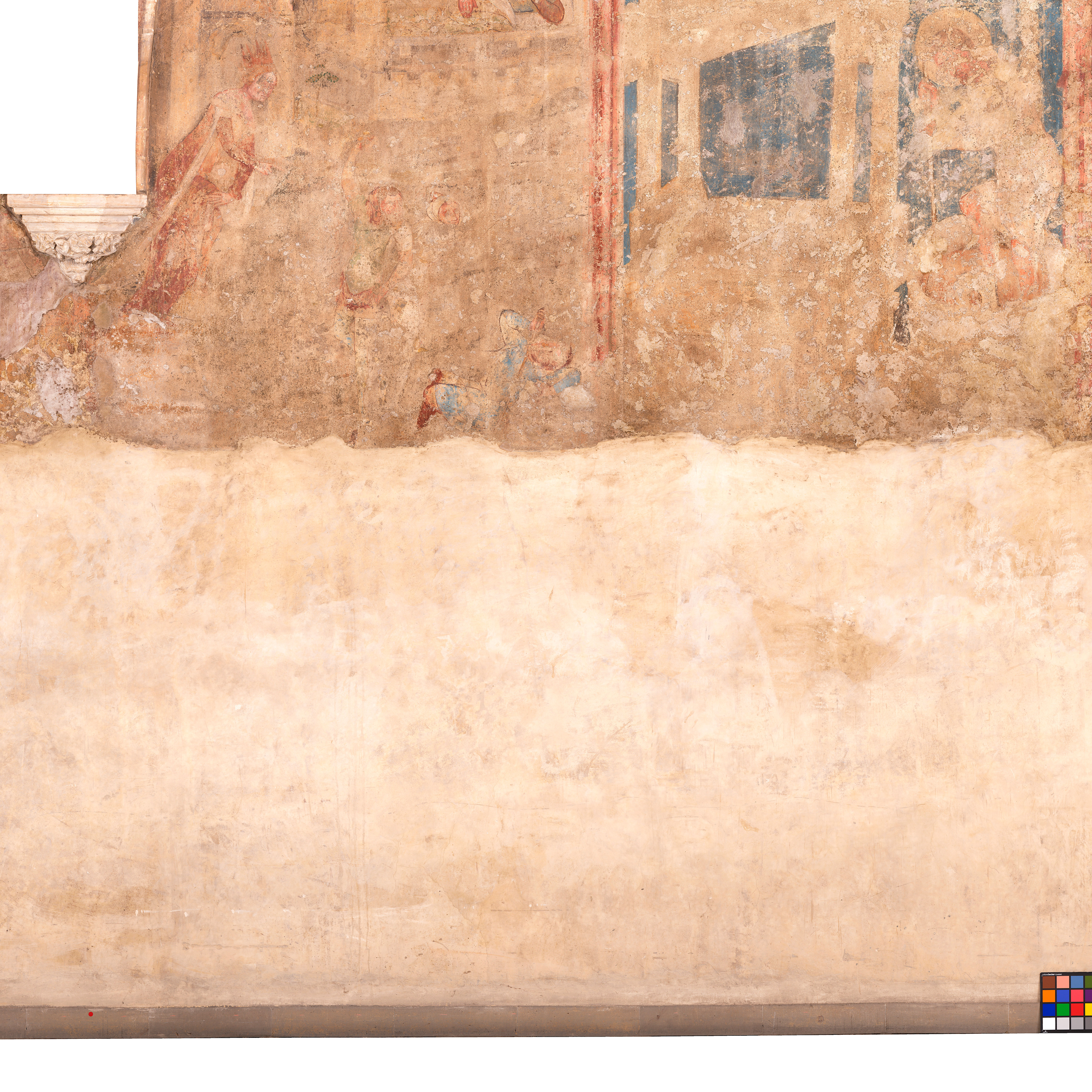
b. The Old Testament scene recounts the story of the cruel Queen Jezebel, who sought to fulfill the wishes of her husband, King Ahab, by acquiring a vineyard belonging to a man named Naboth. Jezebel ordered that Naboth be falsely accused of blaspheming against the Lord. As a result, he was stoned to death, and Ahab seized his vineyard.
The upper half of the scene depicts the royal palace. On the right, King Ahab is shown lying on a bed (the Bible says he lay down after Naboth refused to give up his vineyard). On the left stands Queen Jezebel, leaning slightly forward and pointing downward at two men who are stoning Naboth. Naboth lies on the ground before them.
c. The final scene does not depict an actual historical event but rather serves as an interpretation of one of Isaiah’s prophecies. In a vision, Isaiah saw a man approaching whose garments were stained red, as though he had been treading grapes in a winepress. The man declares that he has trodden the winepress alone. These verses were interpreted in relation to Jesus as a foretelling of his suffering - his garments are stained with his own blood, and the winepress that "pressed out" this blood was the cross.
This interpretation developed into the iconographic motif known as "Christ in the Winepress," which is also depicted here. The majority of the scene is taken up by the wooden structure of the press, and to the right, Jesus is shown treading grapes in the vat. The depiction, however, is rather illogical—if Jesus is meant to be inside the press, he should be standing beneath the pressing beam, which would use pressure from a screw mechanism (seen here to the right behind Jesus) to crush the grapes placed in a rectangular basin. Treading grapes is a different, older method of winemaking. The painter, apparently unfamiliar with how a winepress actually works, seems to have combined the two methods.
Martha Receives Christ in Her Home
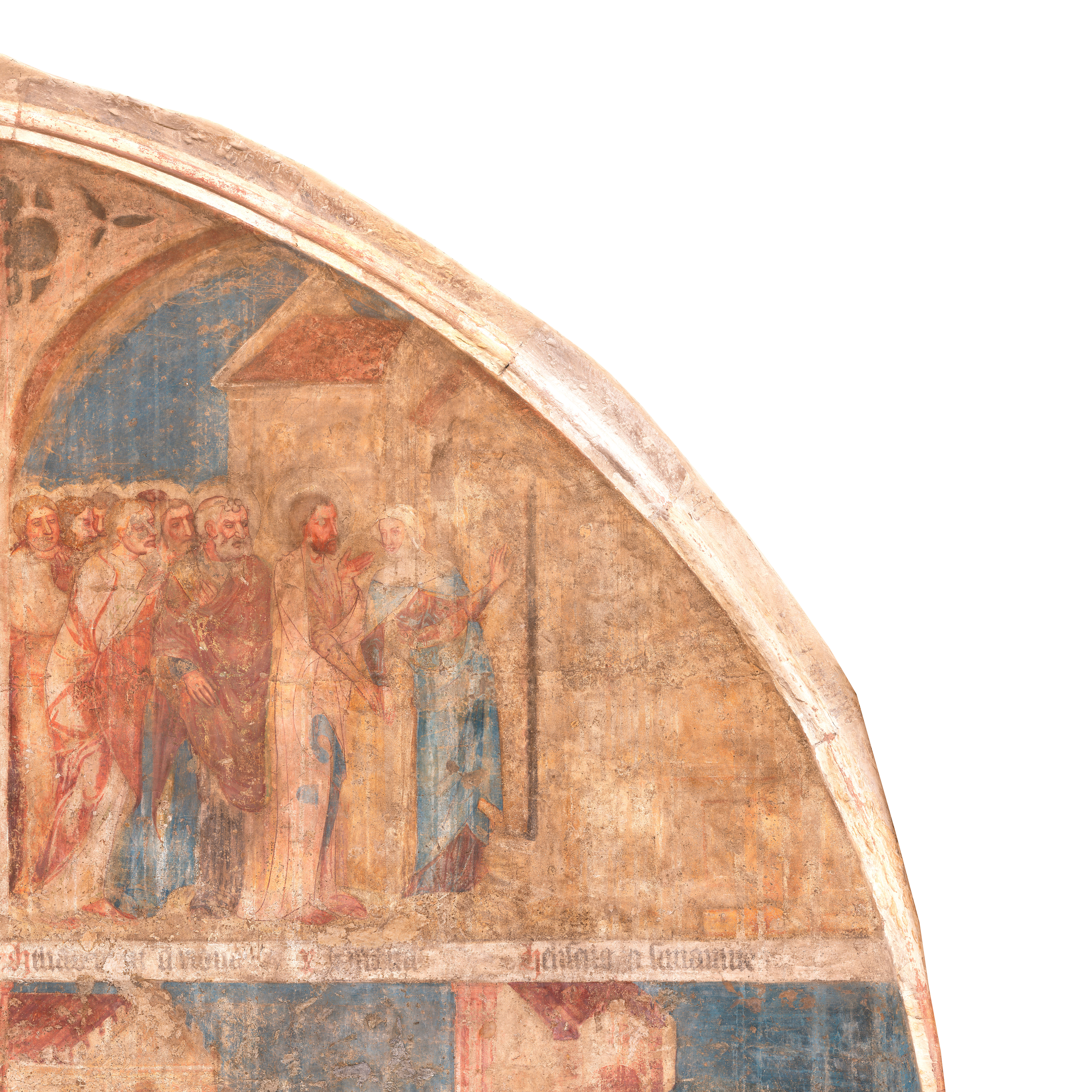
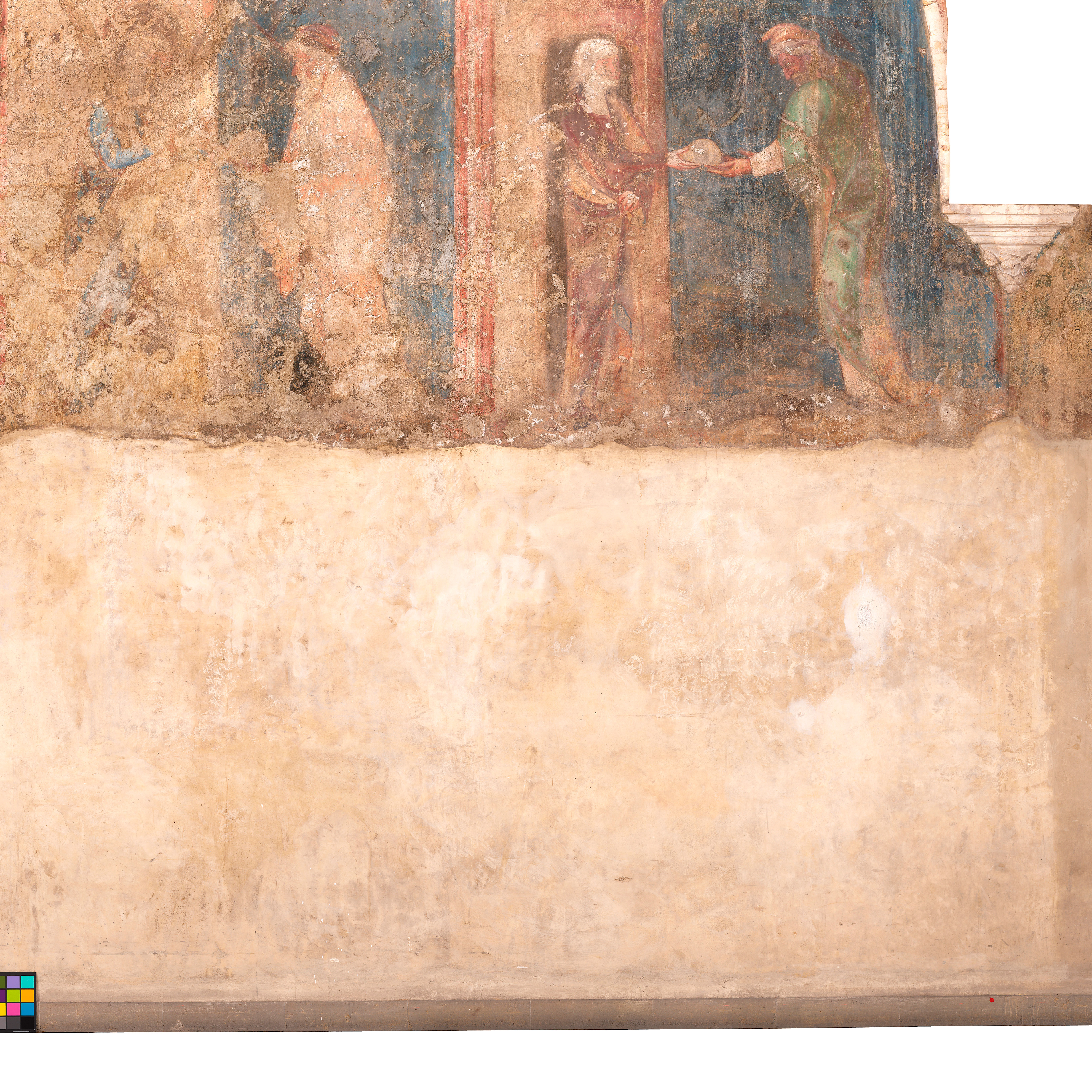
Martha Receives Christ in Her Home (Luke 10:38–42) – Elijah Received by the Widow of Zarephath (1 Kgs 17:8–16) and Elisha with the Shunammite Woman (2 Kgs 4:8)
Inscription: Helias ...it a vidua. X<ptus> <a Mar>ta. Heliseus a Sunamite.
(Elijah [received ?] by the widow. Christ by Martha. Elisha by the Shunammite woman.)
Uppsala description: Vidua in Sarepta Sodomorum Helyam suscipit. Martha Christum suscipit. Et due ymagines scilicet mulier dat viro panem.
(The widow in Zarephath of Sodom receives Elijah. Martha receives Christ. And two figures, namely a woman gives bread to a man.)
a. In all probability, the central scene depicts the moment when Jesus enters a village (i.e., Bethany), where he is received into her home by Martha. However, the Gospel of Luke provides no specific details about their first encounter or his being led into the house. The scene is therefore largely fictional. On the right, a house with partially opened door is shown; Martha is pushing it open with her hand. She slightly turns back toward Jesus, whom she is holding by the hand. Jesus appears to be speaking with Martha, as suggested by the gesture of his left hand. Behind Jesus follows a group of apostles, led by St. Peter and, in the foreground, most likely St. John.
b. The first typological scene returns to the story of the prophet Elijah and the widow of Zarephath. This time, it depicts their initial encounter, when he meets the widow gathering wood at the city gate. The prophet asks her for water and bread.
The woman stands to the left, in the city gate, holding in front of her two large crossed sticks in the shape of a St. Andrew’s cross. The widow was understood as a prefiguration of the Church, and the wood was thus transformed into a cross - a symbol of faith. Opposite her stands the prophet, just receiving a loaf of bread. Elijah is shown in profile as a bearded man in a long robe, wearing a cap on his head.
c. The third scene also returns to a story known from the 16th composition. Here, too, we find ourselves at the beginning of the narrative, when the woman of Shunem invites Elisha to eat bread at her house.
The scene follows the model of the previous one: the woman stands in the doorway and hands the prophet a loaf of bread. The details have changed, however, such as the appearance of the painted architecture of the house, the gestures of both figures, and their facial features.
Martha and both widows were again interpreted as prefiguration of the Church, which nourishes the faithful with bread - that is, the Eucharist. In this sense, the bread given to the prophets by the widows was understood by theologians as a foreshadowing of the sacrament.
Předchozí pole | Následující pole ✖