The Emmaus Cycle | Wall Paintings in Context and Close Up
Missing Scenes in the East Wing in the Imperial Chapel
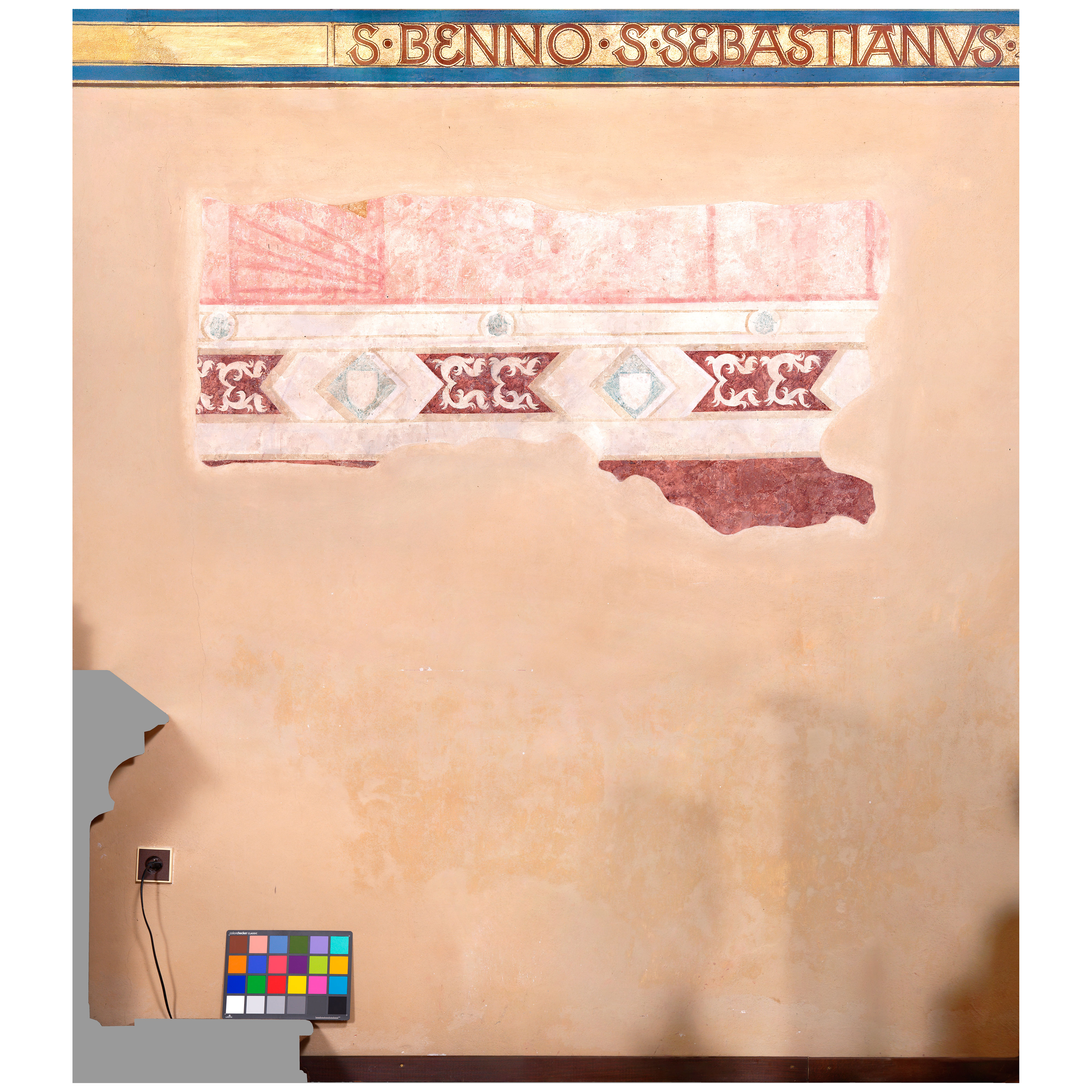
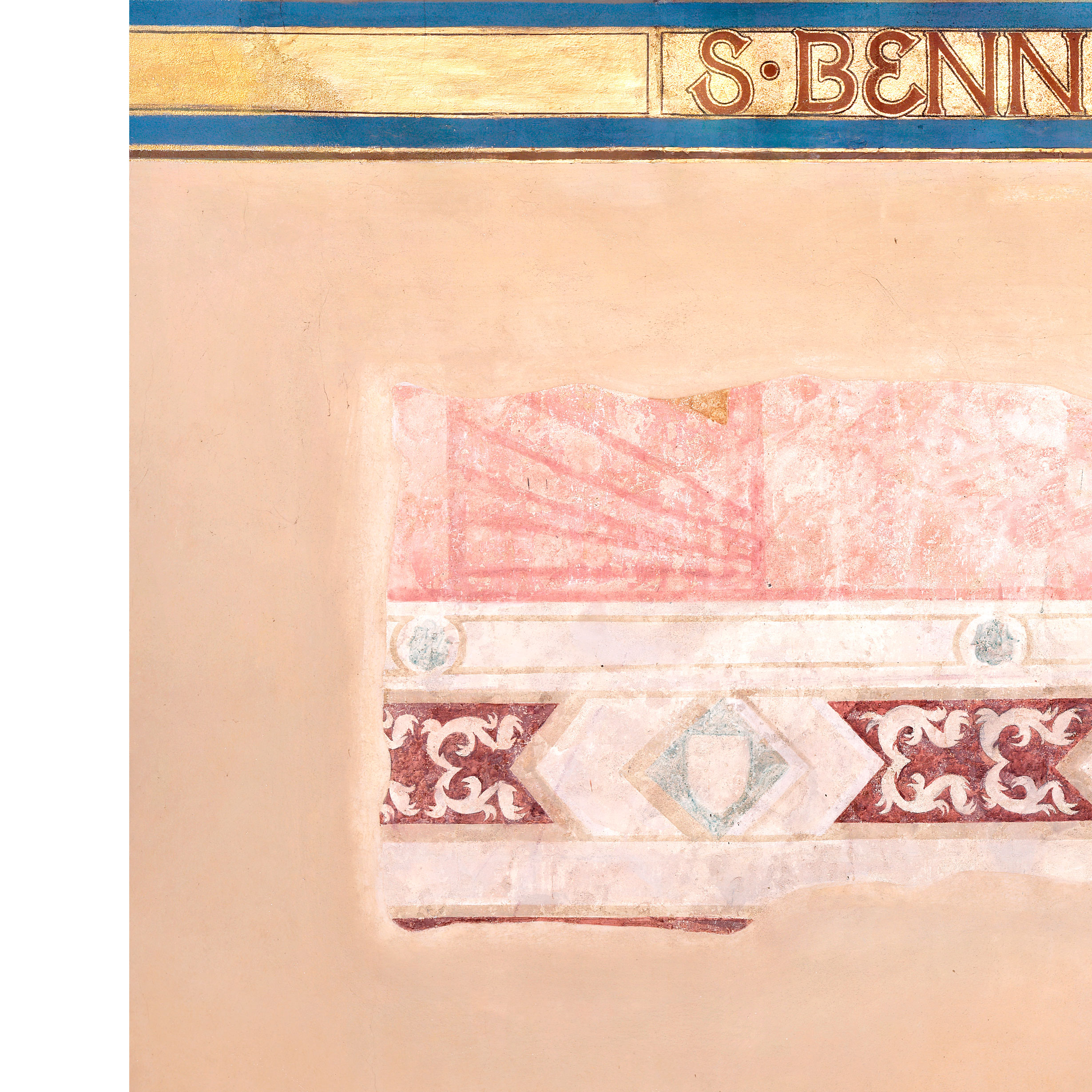
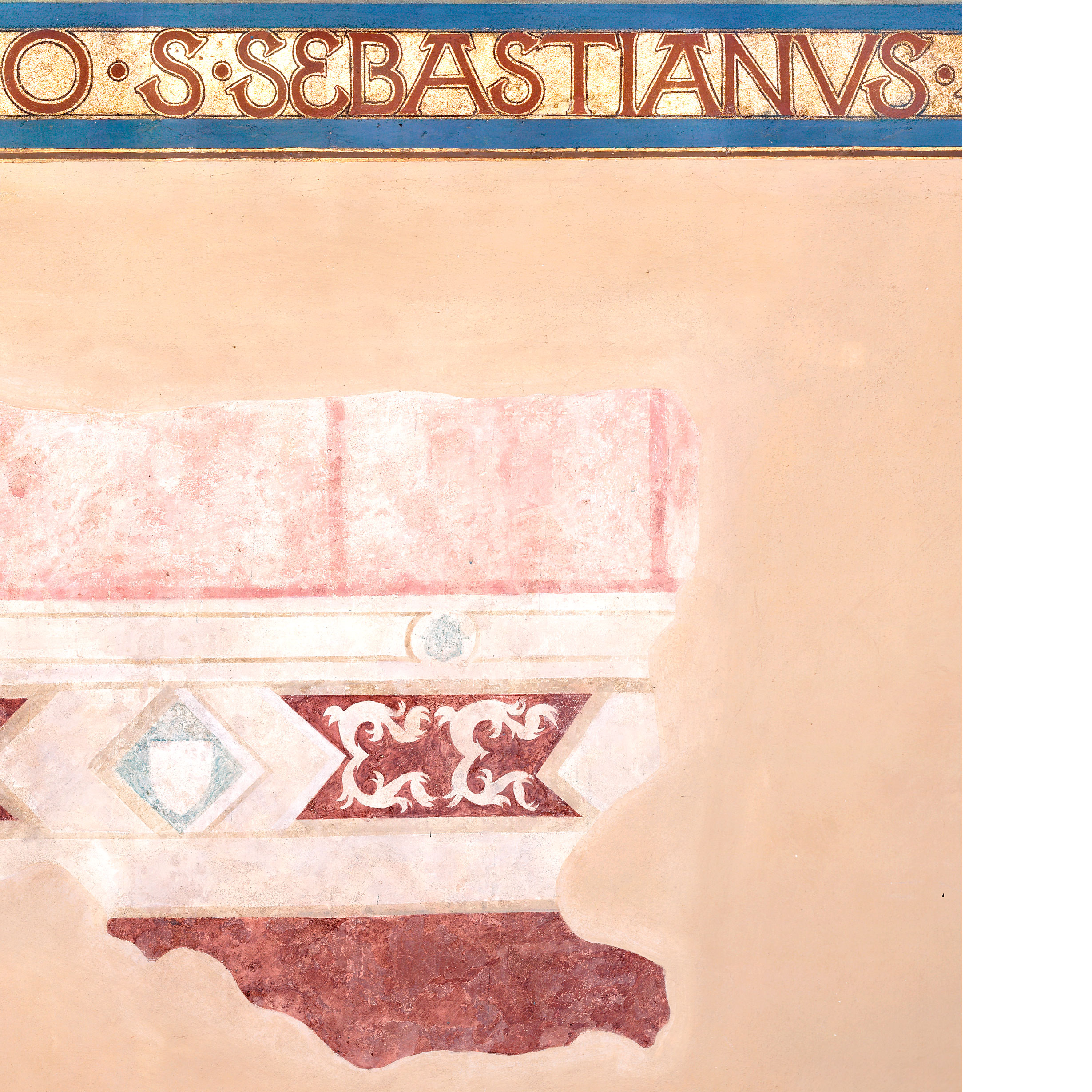
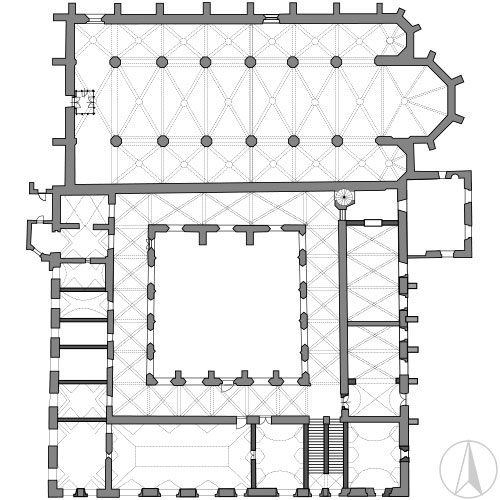
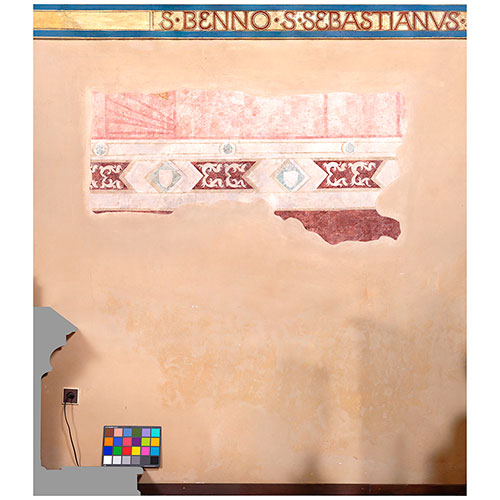
According to the Uppsala description, four additional scenes were located between the Carrying of the Cross and the Resurrection, depicting the central moments of Christ’s Passion. Although it seems that the paintings were originally intended to be accessible through the portal in the central bay of the east wing, the plan was eventually altered. The paintings ended up isolated in a chapel accessible only from the church. It is uncertain whether and for how long the cycle could be viewed as a continuous narrative. The architectural development of the east wing is highly complex. The presence of medieval paintings in what is now the Imperial Chapel is indicated by a fragment of a medieval wall painting with a decorative Cosmatesque motif. Although heavily overpainted, it is likely that it repeated motifs known from the cloister.
27. The Nailing to the Cross – Jubal and Tubal-cain Invent Music (Gen 4:21–22) and Speculum humanae salvationis, Ch. XXIII) and Jael Kills Sisera (Judg 4:17–21)
Uppsala description: Tubal et Tubalcayn a mallei fabrica symphonias adinvenerunt. Christus crucifigitur. Jahel perfodit oculum viri. (Tubal and Tubal-cain invented harmony while working with hammers. Christ is crucified. Jael pierced a man’s eye.)
a. Based on the typological parallels and the fact that the Crucifixion appeared in the next composition, the main scene likely depicted the Nailing to the Cross. This subject was not among the most commonly represented scenes in Passion cycles, as it is not explicitly described in the Gospels. It was only with the development of the Passion cult that detailed accounts of this moment of Christ’s suffering emerged (e.g., Meditationes vitae Christi).
b. The first typological parallel is based on the biblical mention of the brothers Jubal, the ancestor of all who play the lyre and pipe, and Tubal-cain, the master smith. Medieval interpretation turned the two into inventors of music: while Tubal-cain was hammering, Jubal discovered melody in the sounds of the blows. When Christ was crucified, he prayed for his enemies, and this prayer was understood as the beautiful melody that these two Old Testament figures had prefigured.
c. After the Israelite army, led by Barak, defeated the Canaanites, the enemy commander Sisera sought refuge with the Hebrew woman Jael. She offered him hospitality, and when he fell asleep, she drove a tent peg into his head. Jael, as one of the heroic women of Israel, was commonly interpreted as a prefiguration of the Virgin Mary (e.g., Speculum humanae salvationis, Ch. XXX). Why this parallel was chosen here is not entirely clear. Sisera was seen as a figure of the devil, and his defeat with nails might prefigure the devil’s defeat through Christ being nailed to the cross.
28. The Crucifixion (Matt 27:22–41; Mark 15:22–41; Luke 23:33–49; John 19:17–37) – The Raising of the Bronze Serpent (Num 21:6–9) and Angels Contemplate the Passion of Christ
Uppsala description: Serpens eneus exaltatur. Christus crucifixus est. Angelica natura misterium passionis perscrutatur. (The bronze serpent is lifted up. Christ is crucified. The angelic nature contemplates the mystery of the Passion.)
a. The central scene depicted the Crucifixion and formed the climax of the entire cycle.
b. The first typological parallel recounts the story from the Book of Numbers, in which the Lord sent fiery serpents among the Israelites as punishment for their complaints. To protect the people, Moses made a bronze serpent and mounted it on a pole. Whoever looked at it was healed from the serpent’s bite. This prefiguration is one of the most common associated with the Crucifixion scene and appears, for example, in the Biblia pauperum.
c. The final scene can be imagined, based on contemporary analogies, as a depiction of the Man of Sorrows before whom angels kneel in prayer - perhaps holding the instruments of the Passion in their hands.
29. The Piercing of Christ’s Side (John 19:34) – The Striking of Water from the Rock (Exod 17:1–7) and The Baptism Receives Its Efficacy
Uppsala description: Moyses percussit petram et fluxerunt aque. Christi latus aperitur. Baptismus a fluxu sanguinis et aque virtutem accepit.
(Moses struck the rock and water flowed out. Christ’s side is opened. Baptism received its efficacy from the flow of blood and water.)
a. The central scene depicted the moment when, after Jesus’ death on the cross, one of the soldiers pierced his side with a spear, and blood and water flowed out. This soldier was later named Longinus, and Christ’s blood was said to have cured him of his blindness. It is very likely that the scene showed both Longinus on the left side and, on the right, his counterpart Stephaton, who offered Jesus a sponge soaked in vinegar.
b. The Book of Exodus recounts how Moses, when the Israelites were suffering from thirst in the desert, struck a rock with his staff and caused water to spring forth. The water flowing from the rock is paralleled with the water flowing from the wound in Christ’s side.
c. The final scene represented a theological concept: that only at the moment when water and blood flowed from Christ’s side did baptism gain its full spiritual efficacy.
30. The Harrowing of Hell (Matt 27:52–53 and the Gospel of Nicodemus) – The Hanging of Haman (Esth 7:9–10) and Samson Slaying the Lion (Judg 14:5–8)
Uppsala description: Aman ad mandatum Hester suspensus est. Christus vinctos de lacu eduxit. Sampson leonem interfecit.
(Haman was hanged on Esther’s command. Christ brought forth the captives from the pit. Samson killed the lion.)
a. The Harrowing of Hell, Christ’s descent into the limbo after his resurrection to free the righteous souls, is not described in detail in the canonical Gospels. Only Matthew briefly mentions that at the moment of Christ’s death, the tombs opened and many saints were raised. The idea was fully developed in apocryphal literature, particularly the Gospel of Nicodemus. The scene had a fairly standard iconography: from the left, the Risen Christ approaches the gates of the underworld, holding a banner, and extends his hand to the first pair – Adam and Eve.
b. The first typological parallel tells the story of how Queen Esther outwitted Haman, the king’s chief minister and enemy of the Jews. At her instigation, King Ahasuerus ordered Haman to be hanged on the gallows. Haman was understood as a prefiguration of the Devil, while Esther was counted among the great women of Israel and often considered a typological foreshadowing of the Virgin Mary. For that reason, this scene was typically paired with Marian imagery.
c. A very common typological parallel is the story of how the strongman Samson defeated a lion with his bare hands. Samson was viewed as a figura Christi, a figure who foreshadowed Christ through his life and deeds. The scene was usually limited to the depiction of the long-haired youth Samson and his opponent, the lion.
Předchozí pole ✖